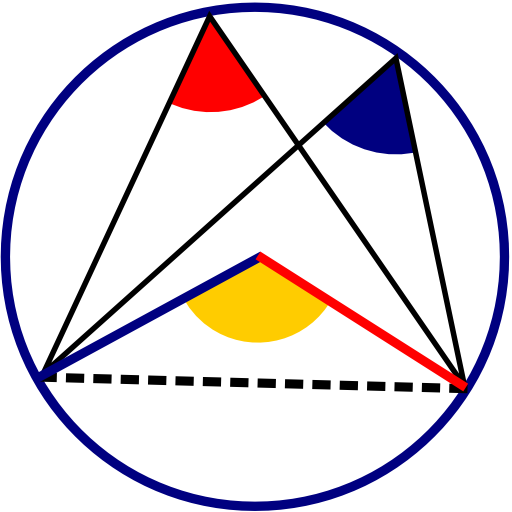
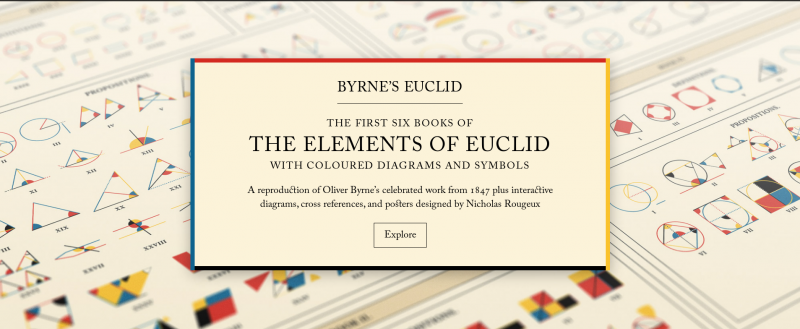
This is astonishing. Designer and ‘data geek’ Nicholas Rougeux has painstakingly recreated all six books of Oliver Byrne’s Euclid on the web, following the original as closely as possible while adding links between propositions and even making the diagrams interactive.
You're reading: News
- have contributed to the field of science
- be real – so no fictional characters please
- not be alive – Her Majesty the Queen is the only exception
- have shaped thought, innovation, leadership or values in the UK
- inspire people, not divide them
- have contributed to the field of science
- be real – so no fictional characters please
- not be alive – Her Majesty the Queen is the only exception
- have shaped thought, innovation, leadership or values in the UK
- inspire people, not divide them
Registration for 2019 Alan Turing Cryptography Competition and MathsBombe is open
The Alan Turing Cryptography Competition, now in its 7th year, is an online competition run by the University of Manchester School of Mathematics, for school students up to year 11 or equivalent. Cryptographic puzzles are released every couple of weeks and teams of up to four compete to solve the puzzles, with prizes for the fastest and other randomly selected correct entries. Registrations are open now, and the competition starts on 28th January 2019.
For sixth form pupils, there is also MathsBombe – an online competition, with two mathematical puzzles released every fortnight. The puzzles are not directly related to the A-Level syllabus but will require students to use their problem-solving skills.
Further information
Here are the mathematicians you nominated to go on the new £50 note
The Bank of England has released a preliminary list of names nominated by the public to appear on the new £50 note. I’ve done a bit of analysis on the list, and present here my findings.
To recap: the Bank asked for nominations satisfying the following conditions:
The released list consists of the names that were nominated in the first week, and belong to people who are real, deceased, and contributed to science ‘in any way’. They haven’t divulged the number of times each name was nominated, or the ineligible names.
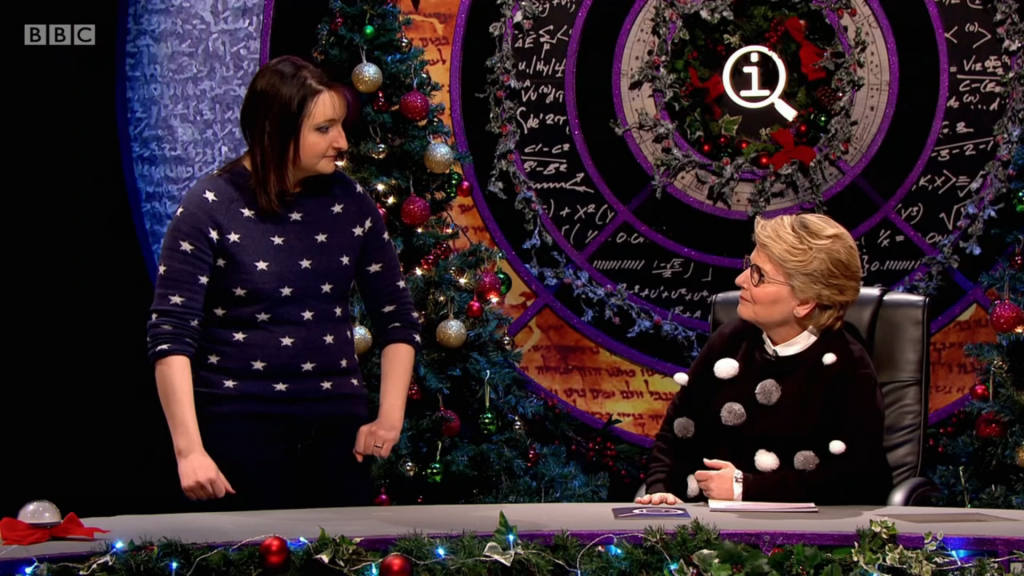
Rachel Riley admits she can’t do maths (but not really)
Eagle-eyed Riley-botherers on Twitter may have noticed this video Rachel tweeted on Saturday:
https://twitter.com/RachelRileyRR/status/1066407882839769090
Kilogram definition to be changed to be based on Planck’s constant
A vote is taking place today at the General Conference on Weights and Measures in Paris, to change the definition of the unit of mass, the kilogram.
Young Researcher applications open for HLF 2019
The Heidelberg Laureate Forum is an annual gathering of maths and computer science prize laureates, including Abel Prize winners and Fields Medalists, together with 200 young researchers from across maths and computer science. It’s a great opportunity for the researchers to meet each other and the Laureates, and see talks from the leading lights in the field. From the HLF press release:
The 7th HLF will take place from September 22 to 27, 2019 […]. This prominent, versatile event combines scientific, social and outreach activities in a unique atmosphere, fuelled by comprehensive exchange and scientific inspiration. Laureate lectures, young researcher workshops and a structure welcoming unfettered discussions are the elements that compose the Forum’s platform.
Over the course of the weeklong conference, young researchers will be given the exclusive possibility to profoundly connect with their scientific role models and find out how the laureates made it to the top of their fields. As described by a young researcher, “It’s a life-changing experience. Getting the opportunity to actually speak to the laureates in close contact can really shape us.”
Applications are now open (until 15th February) for the 2019 HLF – if you are or know someone who’s an undergrad, postgrad or postdoc in maths or computer science who might enjoy a week away in scenic Bavaria with some of the world’s greatest mathematicians and computer scientists, applications can be made at application.heidelberg-laureate-forum.org.
Nominate a mathematician for the new £50 note
The Bank of England is asking for nominations for someone to picture on the new £50 note, and is encouraging it to be a scientist, engineer or mathematician.
This morning @bankofengland made an exciting announcement in our Mathematics Gallery. It's time for a fresh face on the new £50 note! They want to feature a scientist and are asking you to nominate someone noteworthy. #thinkscience https://t.co/VTMgzIWwrt pic.twitter.com/bghF0qFVrz
— Science Museum (@sciencemuseum) November 2, 2018
Non-UK readers might like to know the £50 note is the largest denomination note, rarely seen by most people.
The Bank of England website says:
You can nominate as many people as you like. But anyone who appears on the new £50 note must:
You can suggest anyone who has contributed to the fields of pure or applied science. That could include: astronomy, biology, bio-technology, chemistry, engineering, mathematics, medical research, physics, technology and zoology.
More information
Think science for the new £50 note at the Bank of England’s website.