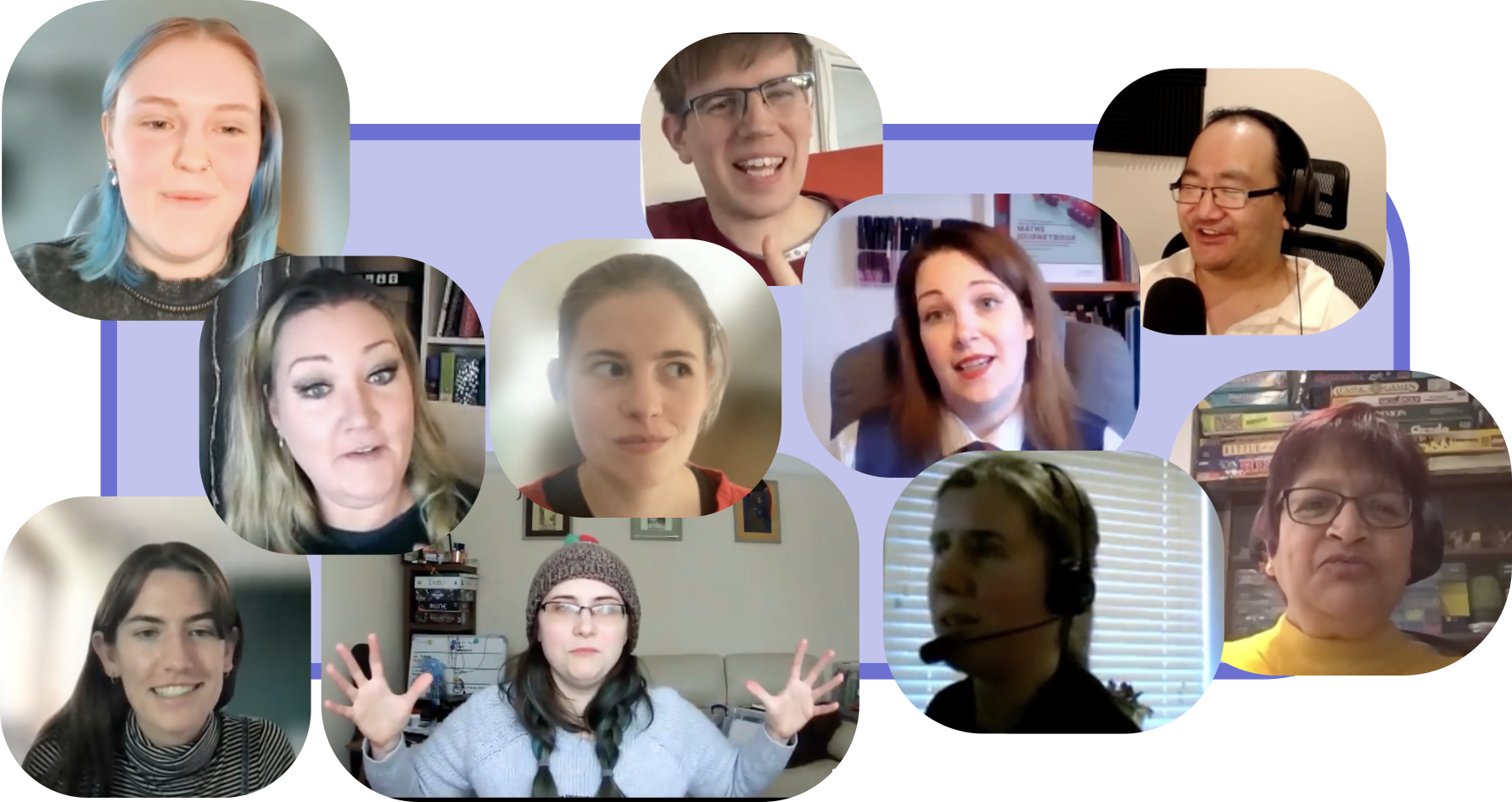
The recordings of the talks are now online, free for anyone to watch. You could go to the official page I put up on Newcastle University’s website, or you could just watch them here!
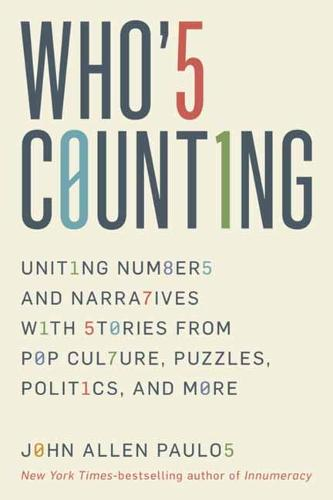
We asked guest author Elliott Baxby to take a look at John Allen Paulos’ latest book, Who’s Counting.
Mathematics is an increasingly complex subject, and we are often taught it in an abstract manner. John Allen Paulos delves into the hidden mathematics within everyday life, and illustrates how it permeates everything from politics to pop culture – for example, how game show hosts use mathematics for puzzles like the classic Monty Hall problem.
The book is a collection of essays from Paulos’ ABC News column together with some original new content written for the book, on a huge range of topics from card shuffling and the butterfly effect to error correcting codes and COVID, and even the Bible code. As it’s a collection of separate columns, it doesn’t always flow fluently – I did find myself losing focus on some of the topics covered, particularly ones that didn’t interest me as much. This was mainly down to the content though – the writing style is extremely accessible and at times witty.
The book included some interesting puzzles and questions, which were challenging and engaging, and included solutions to each problem – very helpful for a Saturday night maths challenge! I even showed some to my friends, who at times were truly puzzled. I loved the idea of puzzles being a means of sneaking cleverly designed mathematical problems onto TV game shows. It goes to show maths is everywhere!
I enjoyed the sections on probability and logic as these are topics I’m particularly interested in. One chapter also explored the constant $e$, where it came from and where else it pops up – a very interesting read. It does deserve more attention, as π seems to be the main mathematical constant you hear about, and I appreciated seeing $e$ being explored in more depth.
This book would suit anyone who seeks to see a different side of mathematics – which we aren’t often taught in school – and how it manifests itself in politics and the world around us. That said, it would be better for someone with an A-level mathematics background, as some of the topics could be challenging for a less experienced reader.
It’s mostly enjoyable and has a good depth of knowledge, including questions to test your mind. While I didn’t find all of it completely engaging, there are definitely some points made in the book that I’ll refer back to in the future!
Here’s a roundup of the maths news we missed in December 2022.
Maths News
The leap second, referred to in this Independent article as a ‘devastating time quirk’, is finally being abolished. This has been covered in a bunch of places, mostly being quite rude about the leap second, including a writeup in the New York Times where it’s referred to as ‘a kludge, a bain, a pain in the little hand’ (£), and this Live Science article (‘pesky’). A committee at the International Bureau of Weights and Measures apparently nearly unanimously voted in support of Resolution D, meaning there won’t be any leap seconds from 2035 until at least 2135.
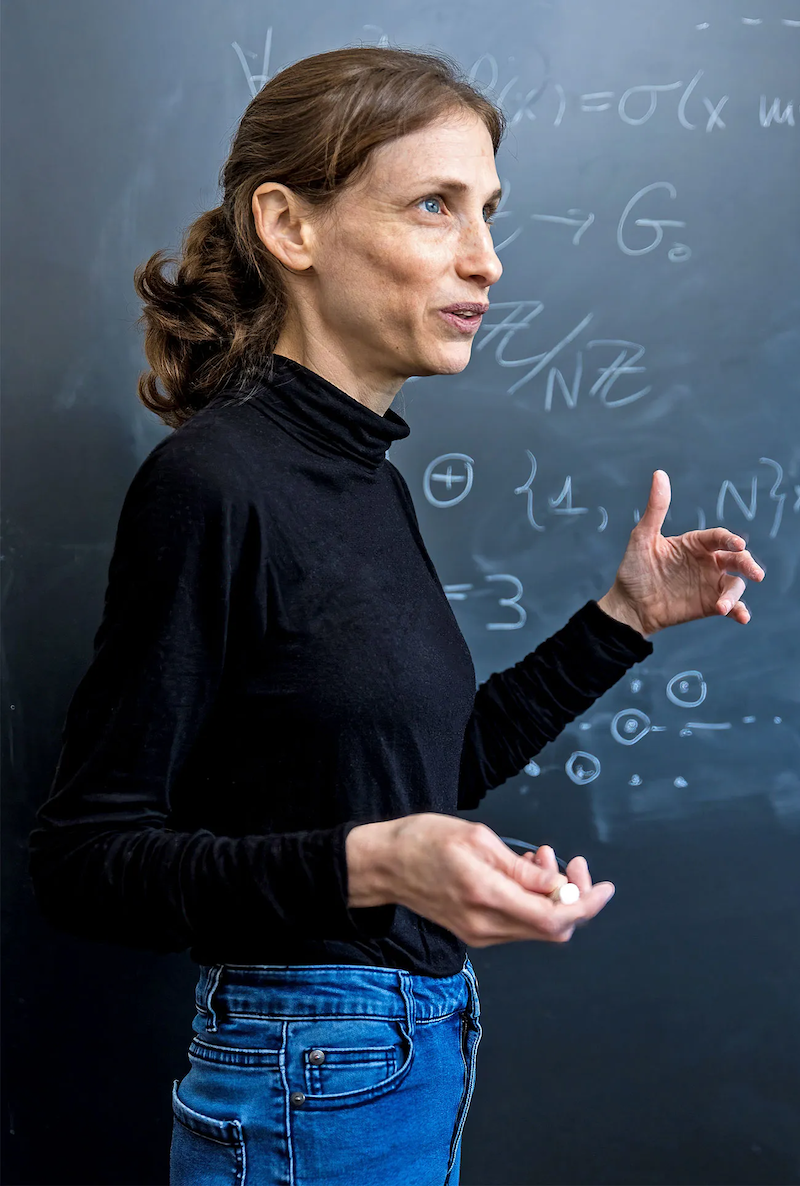
Anti-maths news! Princeton mathematician Rachel Greenfield (pictured left – photo by Dan Komoda/Institute for Advanced Study), working with Fields Medalist Terry Tao, has posted a disproof of the periodic tiling conjecture. A preprint titled ‘A counterexample to the periodic tiling conjecture‘ is now on the ArXiv, and if it’s correct, means that any finite subset of a lattice which tiles that lattice by translations, must tile it periodically. There’s a nice explanation in the Quanta writeup!
Another claimed proof – this time of the sunflower conjecture. A k-sunflower is a family of k different sets with common pair-wise intersections, and the conjecture gives conditions for when such a thing must exist.
Bright-trouser-wearer and mathematician Marcus Du Sautoy is offering a free OU online course, entitled ‘What we cannot know’. Find out how he manages to break the rules of reality by facilitating you knowing something that it’s by definition impossible to know, by signing up online for the 8-week course (which can also be accessed without signing in but then you don’t get a badge).
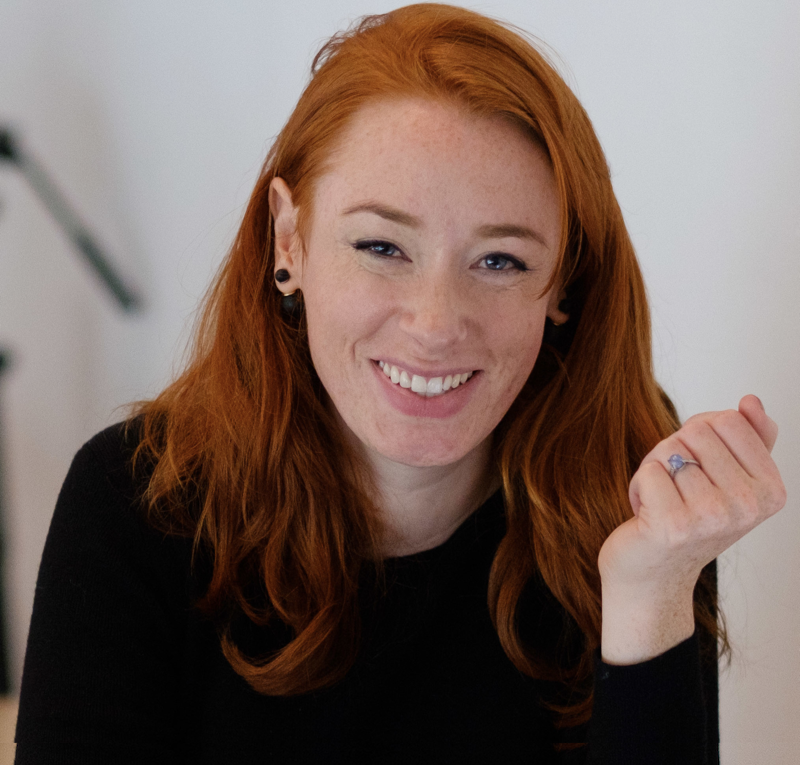
Any excuse to include a photo of HF ❤️
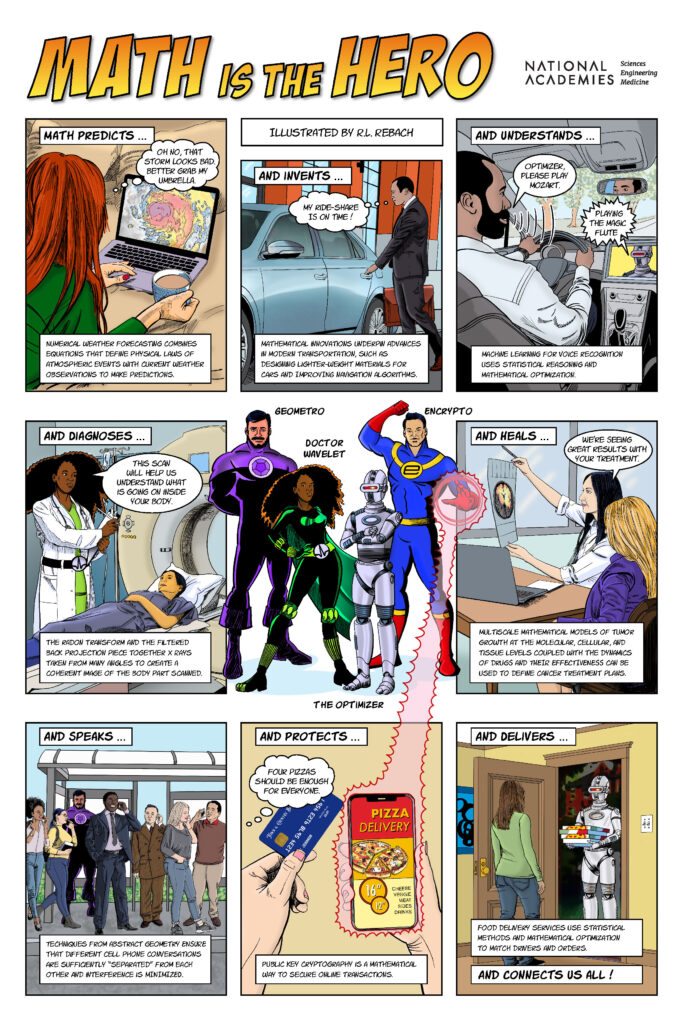
As part of their Elevating Mathematics video competition, the National Academies Board on Mathematical Sciences and Analytics (BMSA) invites early career professionals and students who use maths in their work to submit short video elevator speeches describing how their work in mathematics is important and relevant to our everyday lives, with a $1000 Prize for the best video.
And finally, in a rare instance of us linking to the Hollywood Reporter, Hannah Fry is to front a science and tech series for Bloomberg, entitled The Future With Hannah Fry. Sounds great! It’ll be available on Bloomberg’s Quicktake streaming service and will explore breakthroughs in artificial intelligence, crypto (not clear if -graphy or -currency), climate, chemistry and ethics.
It’s that time of year when we take a look at the UK Government’s New Years Honours list for any particularly mathematical entries. Here is the selection for this year – if you spot any more, let us know in the comments and we’ll add to the list.
Paul Glaister, Professor of Mathematics and Mathematics Education, University of Reading. Appointed CBE for services to education.
Dan Abramson, headteacher of King’s College London Maths School. Appointed OBE for services to education.
Kanti V. Mardia, Senior Research Professor, Leeds University. Appointed OBE for services to Statistical Science.
Jeffrey Quaye, National Director of Education and Standards at Aspirations Academies Trust, PhD in Mathematics Education and Chartered Mathematics Teacher. Appointed OBE for services to education.
Charlotte Francis, maths teacher and entrepreneur. Appointed Medallist of the Order of the British Empire for services to education.
This week and last I hosted a series of public maths talks featuring disabled presenters. I’ll post about how that went later, but for now I just want to share this clip of me filling time spreading Christmas joy.
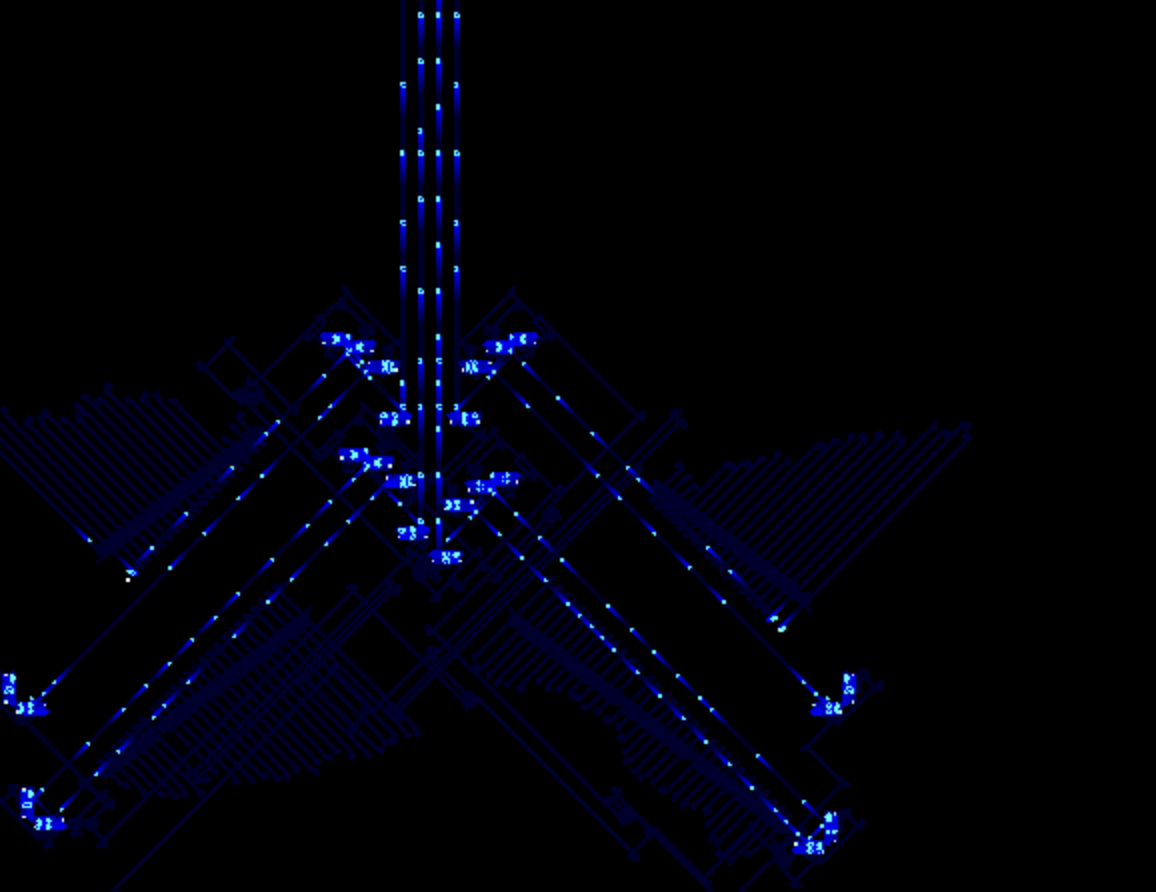
This is a party trick that Katie Steckles showed me: you can fold a piece of paper and then make a single cut to produce a five-pointed star. I showed how to do it by following the instructions I’d been told, and then recreated the steps just starting from the insight that when you make the cut, all the edges of the shape need to be on top of each other.
Maybe you’ll show someone else how to do it during the Christmas holiday?
This doesn’t only work for stars: there’s a theorem that you can make any polygon by folding and a single cut. Erik Demaine has made a really good page about the theorem, with some examples to print out and links to research papers. Katie can cut out any letter of the alphabet on demand, which is impressive to witness!
Recently two articles on the applications of the Rasiowa-Sikorski Lemma to arithmetic were published online in Studia Logica without proper examination and beyond reasonable standards of scholarly rigor. As it turned out, they contained an irrrepairable mistake and, consequently, have been retracted from the journal’s website. The papers will not appear in print.
According to Conway’s Life, a blog which documents developments in research around Conway’s Game of Life, on November 9, 2022 Pavel Grankovskiy discovered that 15 gliders can make any pattern in Conway’s game of life. Given a particular shape, the gliders can be set up to create it (eventually) beating a recent record of 16 gliders. (via Oscar Cunningham on mathstodon,xyz:)
Fields medalist Terry Tao reports some progress on the union closed sets conjecture, an open problem in combinatorics, which has seen rapid developments thanks to (in Tao’s words) ‘maths at internet speed’.
Other News
As of 11th November, applications for Young Researchers for the Heidelberg Laureate Forum 2023 are open. If you or someone you know is a researcher in maths or computer science at undergrad or postgrad level, and would like to spend a week next September in a lovely town in Germany meeting the world’s most decorated mathematicians and computer scientists, you should consider applying!
The latest issue of The Mathematics Enthusiast is a special issue collecting 29 reviews of popular maths books by maths educators, including Matt Parker, Hannah Fry, Eugenia Cheng, Simon Singh and Jordan Ellenberg among many others. If you’re looking for new pop maths book recommendations, it’s a good place to start!
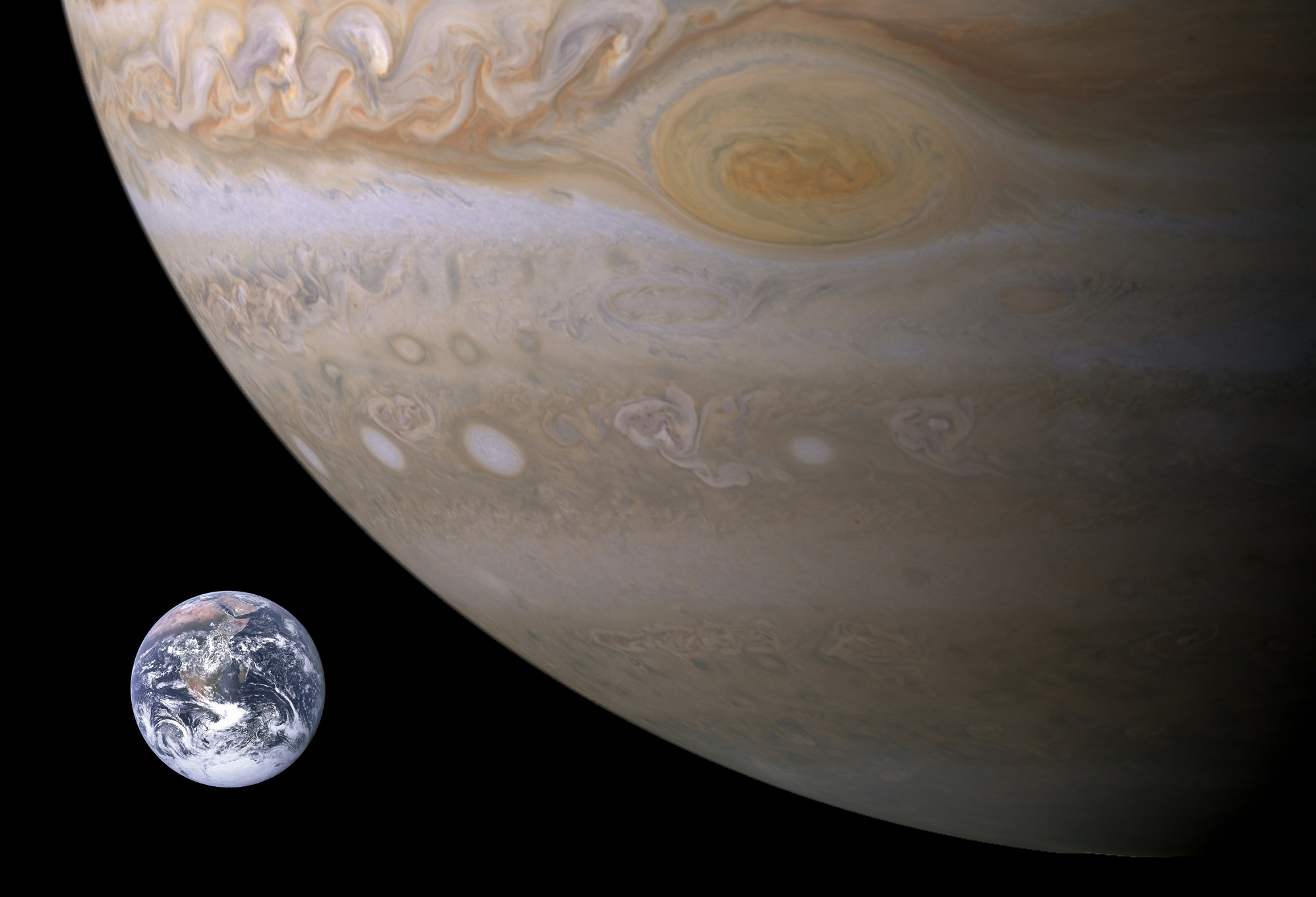
Check out these absolute units (Image: NASA/Brian0918/ Wikipedia Commons)
It was announced earlier this month that having discovered sufficiently many very big and very small numbers, it’s time for some new SI prefixes: ronna-, ronto-, quetta- and quecto- have joined the ranks of things that make numbers bigger and smaller, allowing you to describe itty bitty quantities as small as $10^{-27}$ (ronto) and $10^{-30}$ (quecto), as well as chonky numeros in the region of $10^{27}$ (ronna) and $10^{30}$ (quetta). The earth weighs 6 ronnagrams, and Jupiter is about 2 quettagrams.
“‘R’ and ‘Q’ were the only letters left in the English alphabet that hadn’t been used by other prefixes.”
I’ve put together a series of online public maths presentations, to take place in the last couple of weeks of term before Christmas.
This came about after a few people on the Talking Maths in Public WhatsApp group complained that we can hardly ever take up requests for a speaker to deliver a fun maths talk due to our disabilities, usually because of the difficulty of travelling to and from an event. I quipped that we should set up a series of talks for non-commutative mathematicians, and then I was told that the department’s EDI committee had a load of money sitting unused in its budget. So I decided to use some of it!