Since the British Science Festival’s programme of events for the 2014 festival is now online, you can search through it to find all the mathematical/maths-related events which will be taking place this September in Birmingham. But this is a full-service maths blog, and so you don’t have to because we’ve done it for you. (If you’d rather take a look yourself, the full listing is on the BSA website).
You're reading: Main
- ‘Math’, a t-shirt from Threadless.com featuring an otter playing a guitar and a duck playing a keyboard
- These beautiful pop culture Venn diagrams from Stephen Wildish: Holy Venn Diagrams, Santa Venn diagram, the Von/Van Venn and one on Pancakes
- And finally, a blog post from Reflective Maths, on the difference between a Venn Diagram and and Euler Diagram.
Third Christopher Zeeman Medal to go to Marcus du Sautoy
The Christopher Zeeman Medal for the Promotion of Mathematics to the Public for 2014 has been awarded to Professor Marcus du Sautoy of the University of Oxford.
Not mentioned on The Aperiodical this month – August 2014
As usual in the summer, we’ve all been off doing our own things and consequently neglecting the news queue. Time to break out our tried-and-tested solution: a combo-post summarising everything we failed to cover in depth, before it goes completely out of date.
The Royal Society has Opinions about Education
The Royal Society has released a report outlining their idea of what science and maths education should look like in the future. It’s over a hundred pages long, but they’ve made a nice website to go along with it, with pages summarising their recommendations for things like “stability for curricula” and the teaching profession.
More information: The Royal Society’s vision for science and mathematics education
Cédric Villani is setting up a Maths Museum in Paris
The 2010 Fields Medal winner Cédric Villani announced at Copenhagen’s Euroscience Open Forum last month that there will be a museum dedicated to mathematics, based at the Institut Henri Poincaré, where he is the director. It’s expected to open in 2018.
Source: Cédric Villani annonce la création d’un musée des mathématiques à Paris, in Sciences et Avenir (in French)
Science Magazine establishes a Statistical Board of Reviewing Editors
In response to recent increases in flawed quantitative analysis and statistical bias in papers, Science has announced its intention to establish a Statistical Board of Reviewing Editors to provide better oversight on data interpretation. Recognising that a technical reviewer may not also be fluent in data analysis, the panel will consist of experts in stats and data analysis, and will be sent papers identified by their regular Board of Reviewing Editors (BoRE) as being in need of further scrutiny. Hooray for maths!
More information
Science Magazine raises its statistical bar. Will we? at Chris Blattman’s blog
Raising the Bar, at Science (free registration required to view, because of Science reasons)
Science joins push to screen statistics in papers in the Nature blog
ASA launches ‘This is Statistics’
The American Statistical Association, in a push to provide a new perspective on a subject often misunderstood and considered to be boring, has launched This is Statistics, a new website full of videos, applets and articles outlining how useful and interesting stats can be. It’s aimed at students, parents and educators and includes quizes and case studies of how stats has helped science change lives.
Website: This is Statistics
John Venn is 180
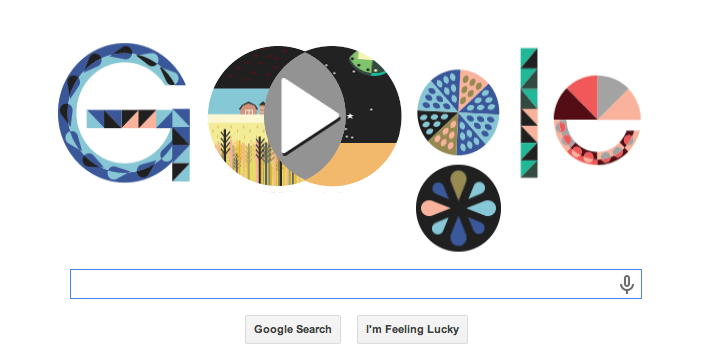
Today is the 180th Birthday of John Venn, inventor of the often-misused mathematical staple the Venn Diagram. In celebration, Google have made today’s Google Doodle be a playful interactive toy where you can select two categories and it’ll show you something in the intersection.
Here’s some of our other favourite Venn diagrams from the internet:
Enjoy Venn-day! I hope that your day is the middle bit of a Venn diagram where the two circles are ‘excellent’ and ‘enjoyable’.
Listen to the premiere of “A Man from the Future”
I could have sworn we posted about the fact the Pet Shop Boys were writing some music about Alan Turing, but I can’t find anything in the archives.
Anyway, the Pet Shop Boys have written a piece of music “inspired by codebreaker Alan Turing”, titled A Man from the Future (not The Man from the Future, the 2011 Brazilian classic), and it was performed for the first time on Wednesday as part of the BBC’s Proms season.
It’s not my cup of tea in the least bit, but we’ve covered every other bit of never-ending Turing centenary news so why not this one?
You can listen to the performance on BBC Radio 3 but, thanks to The Unique Way the iPlayer Works, the actual program starts about six minutes in.
An Alan Turing expert watches the “The Imitation Game” trailer
We weren’t sure quite what to think about the recently-released trailer for The Imitation Game. We don’t know enough about either films or Alan Turing to give an authoritative opinion. James Grime, on the other hand, knows a lot about both…
The trailer for the highly anticipated new film about mathematician Alan Turing was released this week. Alan Turing was not only a mathematician, but also the father of computer science and World War II code breaker. The trailer itself looks fantastic and has me super excited to see the film when it is released this November.
[youtube url=https://www.youtube.com/watch?v=Fg85ggZSHMw]
The Imitation Game stars Benedict Cumberbatch as Alan Turing and Keira Knightley as Joan Clarke. Clarke herself was a mathematician, Bletchley Park code breaker and, briefly, Turing’s fiancée.
The script featured on Hollywood’s blacklist, a list of the best unproduced screenplays, and tells the story of Turing’s early days at Bletchley Park, his work breaking the infamous German Enigma code, and his relationship with Clarke. An early draft of the script caused concern that it over emphasised Turing and Clarke’s relationship, and was accused of “straightwashing” the story of Turing, who was later arrested and convicted for homosexuality.
After seeing the trailer I am more confident it’s going to be done right. So let’s break it down:
Maths movie round up
You wait and wait for a movie about a mathematical genius, and then three come at once. I’ve got Turing, I’ve got Ramanujan, I’ve got Erdős.