The Guardian is reporting that the Government Communications Headquarters (GCHQ) is to trawl social networks for intelligence. The Cheltenham-based organisation is recruiting maths, physics and computing experts to devise groundbreaking algorithms that will automatically extract information from huge volumes of speech, text and image content gathered “across the full range of modern communications media”. Read…
The Joy of $x$, by Steven Strogatz
Steven Strogatz has written a book based on his series of columns for the New York Times, The Elements of Math. The book’s called The Joy of $x$, and Steven’s recorded a trailer for it. I bet he hopes the trailer will convince you to buy the book. [youtube url=https://www.youtube.com/watch?v=GPttaSg8ySc]
World Record Rubik’s Cube Solve
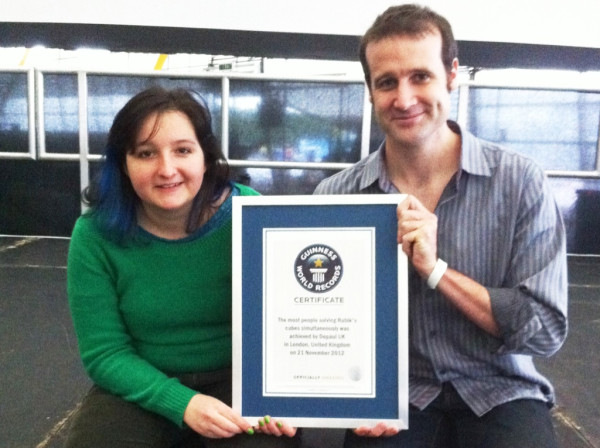
This Wednesday, friend of The Aperiodical Matt Parker compered an event at London’s O2 Arena in which the world record for most simultaneous Rubik’s cube solves was smashed by a crowd including schools groups, individuals, maths fans and the UK’s current speedsolving champion, Robert Yau.
Towards a working definition of the terrifying numbers
Someone — it may have been Matt Parker — told the MathsJam conference last weekend there was now a terrifying number of monthly MathsJam meetups, and a murmur went around the room. It was just about the only audience in the world where more than a couple of people would have asked “how do you…
Tying knots in light
According to this post on phys.org, which reports on this paper in science journal Nature, there’s some beautiful physics which results from tying knots in light. It opens, “New research published today seeks to push the discovery that light can be tied in knots to the next level.” Between us, I wasn’t actually aware of…
Undergraduate conference: Tomorrow’s Mathematicians Today 2013
Tomorrow’s Mathematicians Today 2013 is the second undergraduate mathematics conference to be hosted by the University of Greenwich Department of Mathematical Sciences, with support from the IMA and GCHQ, on Saturday 16 February 2013. Undergraduate students are encouraged to submit an abstract by 1pm on Friday 14 December for a talk on a mathematical topic of…
Declassifying Discoveries by NSA Mathematicians
A petition has been raised for the White House to pressure the USA’s National Security Agency to allow unused discoveries to be declassified, and for “gag order” patents to expire after they have served their purpose. The petition goes as follows: The NSA is the largest employer of mathematicians in the United States. Currently, the…