I made this. Here’s how…

I made this. Here’s how…
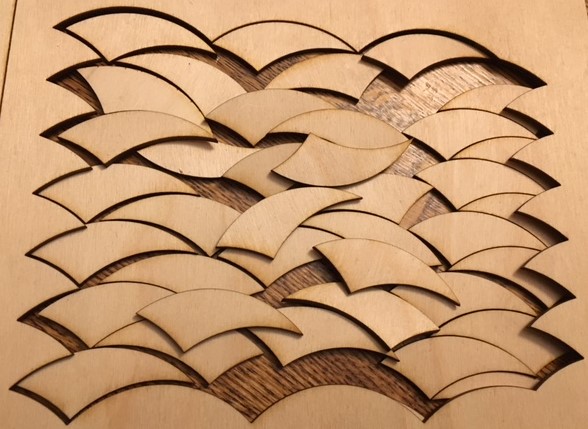
Katie is running an Aperiodical advent calendar (Aperiodvent 2018), with fun maths Christmas treats every day. Behind the door for 7th December was Parabolic Sewing.
This is not unrelated to what I submitted as my entry to The Big Internet Math-Off last summer. I have been revisiting this idea ready for a class next week in my second year programming module.
The next issue of the Carnival of Mathematics, rounding up blog posts from the month of November, and compiled by Ioana, is now online at Life Through a Mathematician’s Eyes.
The Carnival rounds up maths blog posts from all over the internet, including some from our own Aperiodical. See our Carnival of Mathematics page for more information.
For a diagram for a class this week, I’ve written a LaTeX command to draw star graphs using TikZ. A star graph $K_{1,n}$ is a graph with a single central node, $n$ radial nodes, and $n$ edges connecting the central node to each radial node. I am sharing this here in case it is useful to anyone else.
The dust is settling on the ninth Big MathsJam, and before I get too sad that it’s nearly a year until the next one, I put down some thoughts about what was so good about this one.
The Bank of England has released a preliminary list of names nominated by the public to appear on the new £50 note. I’ve done a bit of analysis on the list, and present here my findings.
To recap: the Bank asked for nominations satisfying the following conditions:
The released list consists of the names that were nominated in the first week, and belong to people who are real, deceased, and contributed to science ‘in any way’. They haven’t divulged the number of times each name was nominated, or the ineligible names.
Inspired by Katherine Johnson’s character in the film Hidden Figures and her use of Euler’s Method, engineer Natalie-Claire Luwisha has written this guest post about Euler’s contribution to engineering.
I thoroughly enjoyed Hidden Figures because of the overall message and inspiration it generated for all women, especially women of colour. Even today in the 21st century, most of the STEM (science, technology, engineering and mathematics) industries still have a very low percentage of women and even fewer women of colour. One major factor in this is the lack of visible role models for young girls and women to aspire to, so this story based on real-life events was ideal to help tackle the issue.