We spoke to Nat Alison (@tesseralis), creator of the amazing Polyhedra Viewer.
You're reading: Columns
Combining Tricurves
In July, guest author Tim Lexen wrote about his discovery of the tricurve, a shape made of arcs that has some interesting properties. He’s written a follow-up in which he explores them further. For a discussion of tiling with curve-sided shapes in general, see Tim’s MathBlog post.
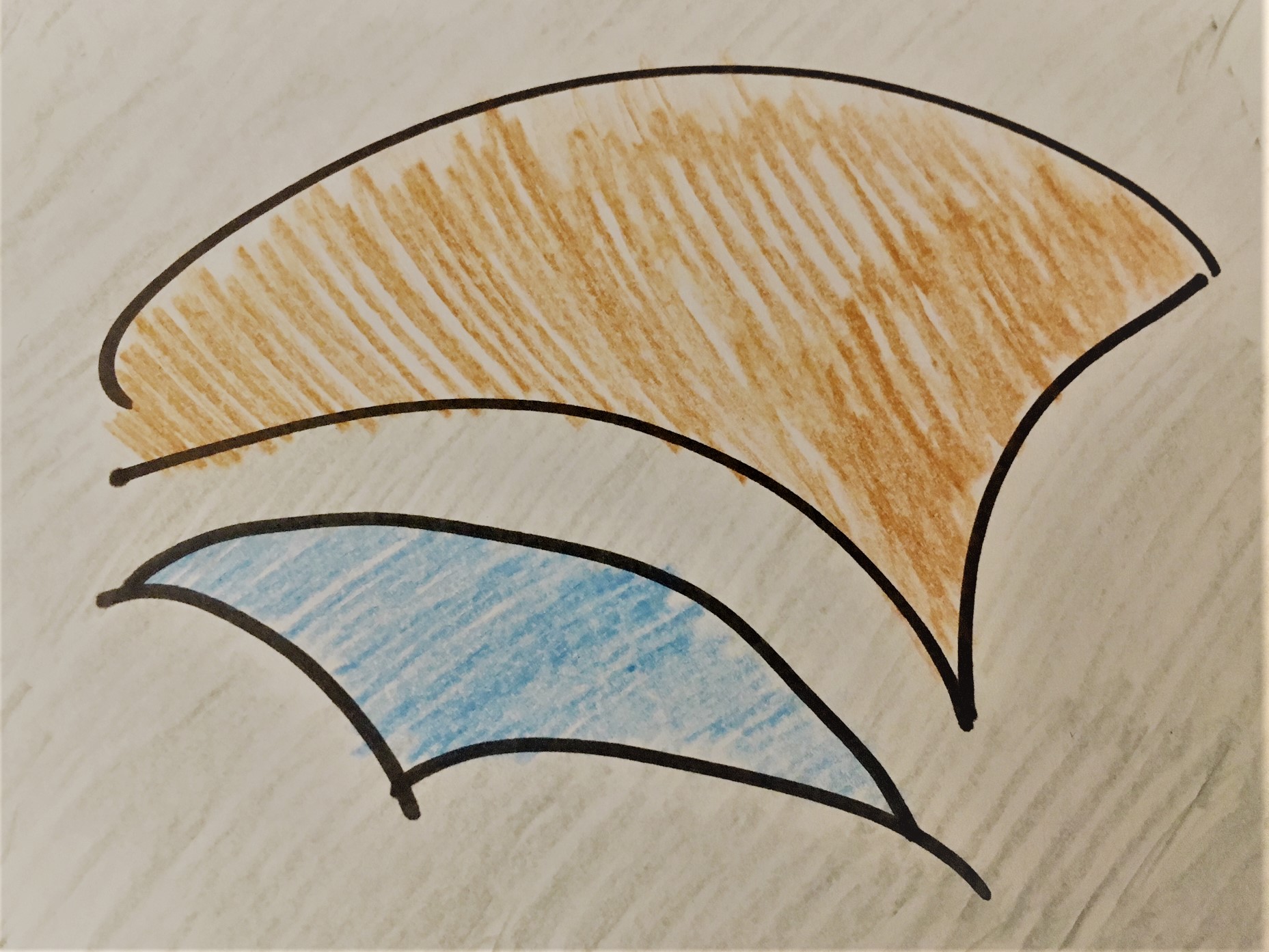
Tricurves can be combined when the large, convex arc of one fills a concave space of another. A tricurve can be thought of as a shape that fills a concave arc with two smaller arcs of the same total length. In each case the new arcs stay within the boundaries of the original structure: touching the same bounding arc. This could go on repeatedly (see below) but we’ll focus here on joining two tricurves. Like the tricurves, assuming agreeable angles, the combined shape will often be able to tile the plane periodically, non-periodically, and radially with itself and related shapes.

Carnival of Mathematics 160
The next issue of the Carnival of Mathematics, rounding up blog posts from the month of July, and compiled by Robin, is now online at Theorem of the Day.
The Carnival rounds up maths blog posts from all over the internet, including some from our own Aperiodical. See our Carnival of Mathematics page for more information.
Bending the Law of Sines
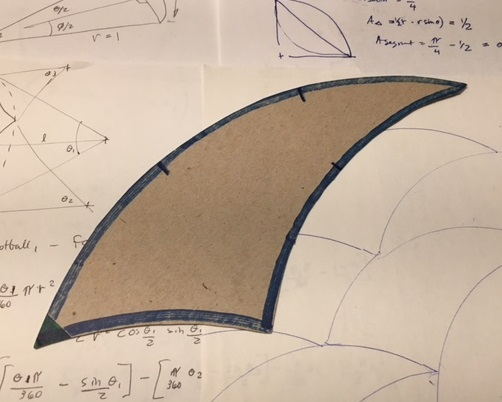
For me, the above shape emerged when playing with a drawing compass. Of the two ancient tools, I preferred the compass over the straightedge. I was fascinated with the classical geometric constructions, the intersecting circles and arcs. As a simple personality test, preferring a compass over a straightedge might mean something: maybe roundabout-holistic-intuitive more than straightforward-linear-realistic. At any rate, the pursuit of curves eventually led me to this topic, but to explain I need to start with straight lines and triangles.
The Big Internet Math-Off: Cheering from the sidelines

Benjamin Leis has been giving some top commentary on the Math-Off matches as they happen, on Twitter. We asked him to share some of his thoughts in more detail
We’re almost at the final of the Big Math-Off and I, your humble and slightly quirky commentator, thought I’d take a look back at the highlights so far. First of all, the format itself is genius. Why go to the beach when you could instead be rooting on for your favorite theorem or mathematical phenomenon? But if you somehow have missed any of the rounds so far, the posts live on and you should take the time to read them all.
Rather than exhaustively survey all the entries so far I thought I would highlight a few that struck a chord with me and what about them was interesting. So first up, since I’m involved in running a middle school math club, I’m always looking for ideas that will transfer to that setting. That generally means: ones only requiring inexpensive easy to procure materials, an idea that requires no more than Algebra and Geometry and which also has a good hook and most importantly, but which rules out a few otherwise excellent entries, it needs to be something that I haven’t done already.
The Mathematical Beauty of the Game SET
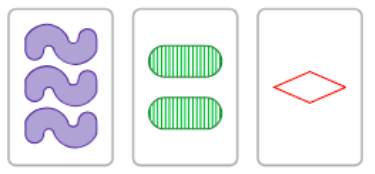
If you are like me, you have played the game SET and have probably been perplexed at how quickly some people can play the game! Even as the game is quite easy to explain, it takes some time to build various strategies and pattern recognition to play the game effectively. If you have never heard of SET, don’t fret because we will soon review its layout. For my final masters project at Texas A&M University, we had the autonomy to research any higher-level mathematical topic and I felt SET would be a great venue to tap into some deeper mathematics. Little did I know how truly complex and elegant SET really is with connections to combinatorial geometry, finite affine geometry, and vector spaces over finite fields, some of these problems still open in research-level mathematics. All of these topics (and more) are included in a great resource I highly recommend for some summer reading. Check out The Joy of Set by McMahon, et al. to dig deeper into what is presented below.
Second place in a single-elimination tournament

I made a silly joke, and it made me think.
You may be aware that our own Christian Lawson-Perfect is running the Big Internet Math-Off here at the Aperiodical, a single-elimination tournament with sixteen competitors. I was knocked out in round one by the brilliant Alison Kiddle. I joked that if Alison went on to win, then I’d be joint second.
Much as I like and respect @ch_nira, I’ll be rooting for @ajk_44. If she goes on to win the #BigMathOff final and is crowned The World’s Most Interesting Mathematician, then I’m joint-second, right? https://t.co/8Jt37gHFif
— Peter Rowlett (@peterrowlett) July 10, 2018
I’ve been mulling this over and I felt there was something there in thinking about the placement of the non-winners in such a tournament, so I had a play.